ISO 55000 and Asset Management Software: What the Standard Requires and How to Meet It
ISO 55000 is the international standard for asset management systems. Published in 2014 and updated since, it establishes the vocabulary, requirements, and guidance that organisations use to manage physical assets throughout their lifecycle. But the standard is frequently misunderstood and frequently misrepresented by software vendors who claim "ISO 55000 compliance" without explaining what that actually means in practice.
This guide explains what ISO 55000 actually requires, which of those requirements touch your software and processes, and what to look for when evaluating asset management tools against the standard.
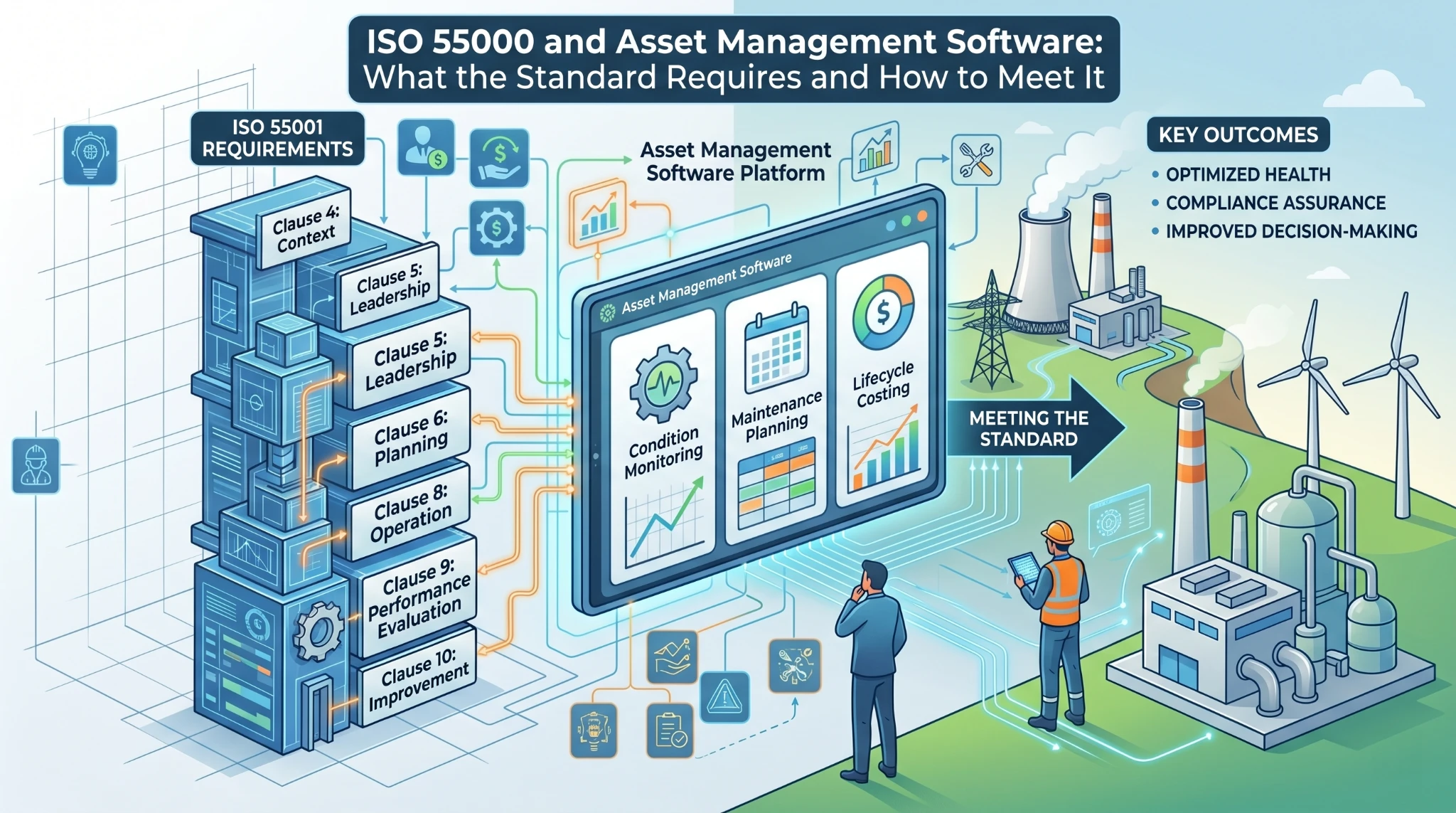
Understanding the ISO 55000 Family
ISO 55000 is not a single document. It is a family of three related standards:
- ISO 55000:2014: Overview, principles, and terminology. Establishes the foundational concepts.
- ISO 55001:2014: Requirements. This is the certifiable standard, the one organisations are audited against.
- ISO 55002:2018: Guidelines for the application of ISO 55001. Provides interpretive guidance.
When people say "ISO 55000 compliance," they almost always mean alignment with ISO 55001, the requirements standard. Software cannot itself be ISO 55001 certified. The certification applies to the organisation's asset management system as a whole, of which software is one component.
No software product can be "ISO 55000 certified." ISO 55001 certification is awarded to organisations, not tools. A vendor claiming their software is "ISO 55000 certified" is either confused or misleading. The right question is: does this software support the requirements of ISO 55001?
What ISO 55001 Actually Requires
ISO 55001 is structured around the Plan-Do-Check-Act (PDCA) cycle and covers ten clauses. The clauses most directly relevant to software selection are:
Clause 6: Planning and Asset Management Objectives
The organisation must establish asset management objectives and create strategic asset management plans (SAMPs) that link to organisational objectives. For software, this means the system must be able to store and surface the asset register, record lifecycle stages, and support planning against defined objectives, not just track maintenance history.
Clause 7.5: Documented Information
ISO 55001 requires extensive documented information to be maintained and retained. For each asset, this includes acquisition records, inspection and maintenance history, condition assessments, incident records, and disposal documentation. The standard requires that this information be controlled, retrievable, and protected from unintended alteration. A spreadsheet or paper file almost never meets this requirement in practice.
Clause 8.3: Management of Change
Changes to assets (modifications, relocations, condition changes, disposal) must be managed through a defined process that assesses risk before the change is implemented. Software must support change records linked to specific assets, with approval workflows and risk assessments attached.
Clause 9.1: Monitoring, Measurement, Analysis and Evaluation
The organisation must monitor and measure its asset management activities against defined performance criteria. This requires software that can generate reports on inspection frequency, defect rates, maintenance completion rates, and asset condition trends, not just individual records.
Clause 10.2: Nonconformity and Corrective Action
When a nonconformity is identified (a failed inspection, a defect, or an incident) the system must record it, initiate a corrective action, track that action to completion, and verify effectiveness. The closed-loop from identification to resolution to verification must be documented.
Where Most Asset Management Tools Fall Short
Most tools marketed as "asset management software" focus on the asset register and maintenance scheduling. These are necessary but not sufficient for ISO 55001. The gaps that most commonly cause audit findings are:
| ISO 55001 Requirement | Basic CMMS / Spreadsheet | Pervidi |
|---|---|---|
| Asset register with lifecycle stage | Yes | Yes |
| Inspection history linked to asset | Partial | Yes: full history, photo evidence, signatures |
| Offline field capture | No | Yes: works without connectivity |
| Closed-loop corrective actions | No | Yes: defect to work order to sign-off |
| Change management records | No | Yes: asset modification and transfer history |
| Performance reporting (Clause 9.1) | Limited | Yes: configurable dashboards and scheduled reports |
| Controlled, retrievable documentation | No | Yes: tamper-evident records with audit trail |
| Integration with ERP/CMMS | No | Yes: REST API and pre-built connectors |
The Role of Inspection Software in an ISO 55001 System
ISO 55001 does not mandate any specific technology. What it mandates is that your asset management system (the combination of people, processes, and tools) can demonstrate the outcomes the standard requires. In practice, inspection and asset management software is the primary mechanism through which most organisations meet Clauses 7.5, 8.3, 9.1, and 10.2.
The critical capability is not any individual feature. It is the connected record. An ISO 55001 auditor needs to be able to trace:
- An asset in the register
- Its complete inspection and maintenance history
- Any defects identified, and the corrective actions raised
- Evidence that those corrective actions were completed and verified
- Performance data showing the asset management system is achieving its objectives
If any link in that chain is broken (because records are on paper, because the inspection system does not connect to the maintenance system, or because corrective actions are tracked in a separate spreadsheet) the organisation cannot demonstrate conformance, regardless of how good any individual component is.
Practical Steps for ISO 55001 Alignment
Step 1: Establish a controlled asset register
Every physical asset within scope must be recorded with its unique identifier, location, condition, and lifecycle stage. The register must be actively maintained, not a static list. Use your asset management software as the single source of truth, not a spreadsheet that is occasionally updated.
Step 2: Link every inspection to an asset
Inspections conducted in the field must be tagged to the specific asset being inspected: by barcode scan, QR code, NFC tag, or GPS location. An inspection record that refers to "the generator on site 3" rather than a specific asset ID is not retrievable and not auditable.
Step 3: Close the loop on every defect
Every defect identified in an inspection must generate a corrective action or work order automatically. That work order must be tracked to completion, and the completion must be verified and recorded against the original defect. Manual hand-off processes break this chain.
Step 4: Generate performance evidence
ISO 55001 Clause 9.1 requires evidence that your asset management objectives are being met. Configure your software to produce scheduled reports on inspection completion rates, defect resolution times, asset condition trends, and maintenance KPIs. These reports become the evidence pack for your management review and your certification audit.
Step 5: Retain records for the required period
ISO 55001 does not specify a retention period, but most organisations set a minimum of seven years for asset records. Ensure your software stores records in a format that will remain readable and retrievable over that period, and that access controls prevent deletion or alteration of historical records.
Frequently Asked Questions
Can we achieve ISO 55001 certification without dedicated software?
Technically yes. The standard does not require software. In practice, organisations with more than a handful of assets almost always find that paper-based or spreadsheet-based systems cannot consistently meet the documented information and performance monitoring requirements at audit time. Software is not mandatory; reliable records are.
How long does ISO 55001 certification take?
For most mid-sized organisations, the implementation journey from gap assessment to initial certification typically takes 12 to 24 months. The largest time investment is usually in establishing consistent processes and building the documented information base, not in the audit itself.
Does ISO 55001 apply to all asset types?
ISO 55001 applies to physical assets. The organisation defines the scope. It can be applied to a single facility, a fleet, an infrastructure network, or an entire organisation's asset portfolio. The standard does not require that all assets be in scope, but the scope must be clearly defined and consistently applied.
Next Steps
If your organisation is working toward ISO 55001 certification, or needing to demonstrate asset management capability to clients, insurers, or regulators, the foundation is a connected, retrievable record system that covers the full asset lifecycle from acquisition to disposal.
Pervidi's asset management platform is designed to provide exactly that foundation: a single system that connects inspection records, maintenance history, corrective actions, and performance reporting, all linked to individual assets and accessible from the field on mobile devices, online or offline.
See how Pervidi supports ISO 55001 requirements
Book a 30-minute demo. We'll walk through asset registers, inspection history, corrective action workflows, and the performance reports your auditors will want to see.
Book a demoNaaman Shibi is a VP at Pervidi Software, leading the adoption of AI-powered inspection and compliance solutions across industries including mining and construction. With more than 25 years of experience in digital transformation, Naaman has helped organisations replace paper processes with efficient mobile technology. His focus is on delivering practical innovations, from AI image integration to predictive maintenance, that empower frontline teams and improve operational outcomes.