Australian Standards for Council Asset Inspections: Parks, Plant and Transport
Local councils manage more field assets than almost any other class of local government infrastructure: shade trees, play equipment, public toilet blocks, park furniture, depot plant and fleet, and a footpath and road network spread across every corner of the municipality. Each asset type is inspected against a different Australian Standard or a different legal obligation, sometimes a combination of two or three plus a state Act, which makes it easy for an inspection program to end up as a patchwork of local policy rather than a defensible, standards-based system.
This guide sets out which standards and obligations actually apply to trees, playgrounds, public toilets, open space furniture, plant and fleet, and the transport network, and how councils are using mobile inspection software to apply them consistently across every asset class. For a broader look at choosing mobile inspection software for local government, see our guide to mobile inspection software for councils.
An Asset Management Framework Before the Standards: AS ISO 55000
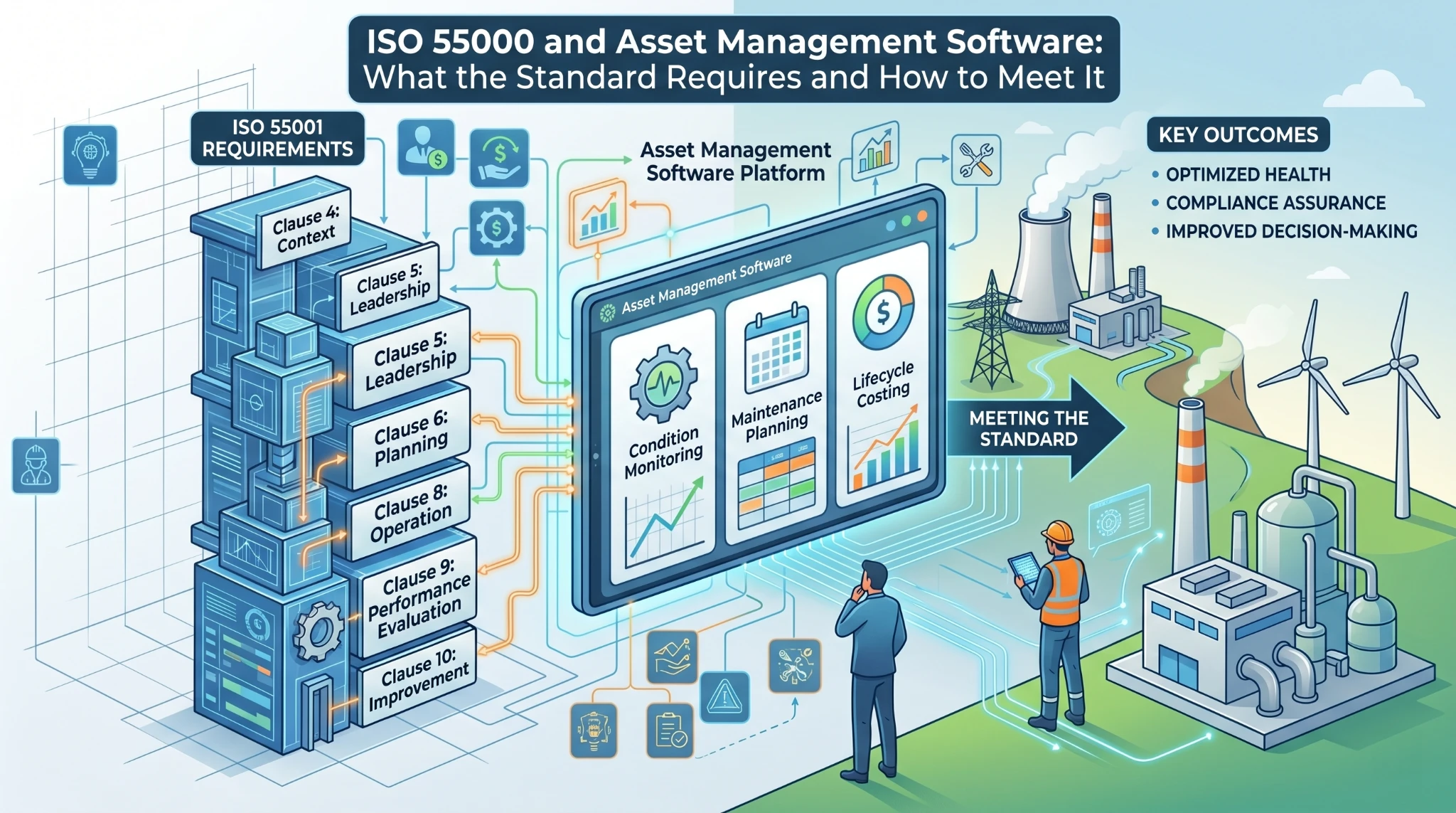
Before getting into asset-specific standards, it helps to understand the framework most Australian councils sit them under. AS ISO 55000 is the Australian adoption of the international ISO 55000 series and sets out the requirements for an asset management system: the policies, objectives, and processes an organisation uses to manage the value of its physical assets across their whole lifecycle. For a council, this is the umbrella that covers every asset class in this guide, trees, playgrounds, toilets, furniture, plant, fleet, and the road network, rather than a specific inspection method for any one of them.
Alongside AS ISO 55000, most Australian councils also use the Institute of Public Works Engineering Australasia's International Infrastructure Management Manual. It is not an Australian Standard but a widely adopted industry framework, and its five-point condition rating scale gives councils a consistent way to score a park bench, a toilet block, a hazard tree, and a footpath defect side by side, feeding the same corporate asset register. For a full breakdown of what AS ISO 55000 requires from your software and processes, see our guide to ISO 55000 and asset management software.
Trees and the Urban Canopy
Tree inspection sits under AS 4373-2007 Pruning of Amenity Trees, which sets the accepted techniques, wound response, and clearance requirements council arborists and contractors are expected to follow when pruning street and park trees. Where a development or council works project affects a tree's root zone, AS 4970-2009 Protection of Trees on Development Sites governs how the tree protection zone is defined and maintained during construction.
Hazard identification is the other half of tree inspection, and it sits outside a specific Australian Standard. Most councils use a Visual Tree Assessment method to score structural defects, decay, and dieback, carried out on a routine cycle and again after storm events, with results scored against the same condition scale used for the rest of the park network. Many councils also maintain a Significant Tree Register under their local planning scheme, which adds its own inspection and approval requirements for listed trees; the detail of this varies significantly by state and even by council.
Playgrounds and Play Equipment
Playground equipment is inspected against the AS 4685 series, covering everything from swings and slides to climbing nets and rocking equipment, alongside AS 4422 for impact-attenuating surfacing. Councils typically run this as three layers: a routine visual check monthly or quarterly, a more detailed operational inspection by a trained person, and a comprehensive annual inspection assessed against the full AS 4685 series, a cadence Kidsafe Australia also recommends. We cover the full AS 4685 breakdown, and what to look for in playground inspection software specifically, in our guide to mobile inspection software for councils.
Playgrounds are also one of the clearest examples of why a standards-based checklist needs to end in a decision, not just a pass or fail. A defect found against the AS 4685 series is usually coded by severity, and the outcome ranges from a scheduled repair, to quarantining the equipment until it is fixed, to immediate removal for a serious entrapment or structural risk. With a council typically managing playground equipment across dozens or hundreds of individual sites, this is also where risk scoring earns its keep: it lets a parks team prioritise the handful of defects that carry real injury risk over the much larger volume of minor, low-risk items, rather than treating every finding as equally urgent.
Public Toilets and Amenities Blocks
There is no single Australian Standard called "public toilets." Instead, council toilet block inspections typically draw on three separate sources. AS 1428.1 sets the accessibility requirements for the unisex accessible toilet, including clear floor space, grab rail position, and door swing. AS/NZS 3500.1 and AS/NZS 3500.2 govern the water supply and sanitary plumbing councils check for leaks, blockages, and backflow prevention during maintenance inspections. And the National Construction Code sets the minimum number and type of sanitary facilities required, calling up both standards depending on how the structure is classified.
Day-to-day toilet block inspections, cleanliness, consumables, lighting, and vandalism, are driven by each council's own service-level policy rather than a specific clause in a Standard, but the record still matters for the same reason as any other park asset: if someone is injured on a wet floor or a broken fitting, the inspection history is what shows whether the asset was being checked and maintained on schedule. Some councils are also adding Changing Places accessible facilities at high-use reserves, a national program that sits alongside, not inside, the AS 1428 series.

Parklands, Open Space and Park Furniture
Benches, shelters, bins, fencing, and signage do not carry a single dedicated Australian Standard the way playgrounds and pools do. Where they intersect with accessibility, AS 1428.2 governs path gradients and clearances through a reserve, and AS 1657 applies to any fixed platform or elevated walkway, such as a lookout in a regional park. For most park furniture, councils build their inspection checklist from a risk-based work health and safety approach rather than a clause-by-clause Standard, scored against the same condition scale used for trees and buildings.

Which of these standards and registers apply, and how strictly, varies by state and even by individual council policy. A Significant Tree Register, a Changing Places program, or a heritage overlay over parkland can add requirements on top of the national standards described here. Inspection software needs to support checklists configured to the exact combination that applies in your council area, not a single generic template.
The same standards-based approach extends naturally beyond parks and open space to two more council asset classes that share the same volume, frequency, and risk profile: plant and fleet, and the transport network.
Plant and Fleet
Plant and fleet do not sit under a single dedicated Australian Standard the way playgrounds do. Instead, the obligation comes from work health and safety law itself: the model WHS Regulations require plant to be inspected, maintained, and where necessary tested by a competent person, so it does not become a risk to anyone who operates or works near it. For heavy vehicles specifically, the National Heavy Vehicle Regulator's Chain of Responsibility obligations effectively mandate a documented daily pre-start check covering mass, dimensions, loading, and vehicle condition before a vehicle leaves the depot.
In practice, this becomes the same structure used across every other asset class in this guide: a checklist, a logged defect, a corrective action, and sign-off by a competent person before the item returns to service. Because pre-starts happen daily and a council fleet is spread across multiple depots, a defect that keeps recurring on one vehicle, or across every vehicle from a particular manufacturer or model, is a pattern that is far easier to see in a digital inspection record than in a stack of paper log books.
Transport: Footpaths, Roads and Street Furniture
Footpath trip hazards and road defects are one of the most common drivers of negligence claims against Australian councils, which is why inspection-and-defect software for the road and footpath network is already a mature category in local government. Road pavement and footpath condition is an engineering assessment rather than a compliance check against a single Australian Standard, so most councils rate it using an AUSTROADS-aligned condition scale built into their asset management system, the same kind of framework AS ISO 55000 and the IPWEA IIMM set out above.
In several states, road authority legislation, such as the NSW Roads Act 1993, gives councils a statutory defence against a negligence claim over a road or footpath defect if council did not have actual knowledge of it. A documented, scheduled inspection program is what allows a council to demonstrate that position, regardless of which specific defence applies in that state. Because the network is large and geographically dispersed and inspections are routine and photo-driven, this is also where risk-based prioritisation earns its keep: rating each defect for severity and likelihood lets a council target repair budgets at the footpaths and road sections most likely to cause harm, rather than defaulting to a blanket resurfacing program or a purely reactive, complaints-driven queue.
Where Paper-Based Inspections Fall Short
Most councils did not choose paper forms and spreadsheets for asset inspections deliberately. They accumulated them as parks, buildings, depot, and roads teams each solved their own reporting problems separately. The result is usually a familiar set of issues:
- Fragmented records: Tree, playground, toilet, furniture, plant, and road inspections sit with different teams, so nobody has one view of asset condition across the whole council.
- Delayed action on hazards: A hazard tree, a broken piece of play equipment, a recurring vehicle defect, or a footpath trip hazard noted on a paper form has to be typed up and assigned before anyone starts work on it.
- Weak evidence for liability claims: A folder of signed paper sheets is far harder to defend than a timestamped, photographed inspection history when a claim is made against council over a park asset, a road, or a footpath.
- Inconsistent condition scoring: Without a shared checklist and rating scale, different inspectors record different levels of detail, particularly for trees, furniture, and plant, where there is no single Standard to check against.
What to Look for in Mobile Inspection Software for Council Assets
Separate checklists for every asset type
Tree hazard assessment, playground compliance, toilet block maintenance, furniture condition, plant and fleet pre-starts, and footpath or road defect capture each need their own conditional questions and risk scoring, built and maintained in one platform rather than a generic form stretched to fit every asset.
Offline capture across every reserve, depot and road corridor
Bushland reserves, regional roads, and depots on the edge of town often have no mobile signal. Inspection software needs to store checklists, photos, and GPS data on the device and sync automatically once a connection is available.
Photo, GPS, and timestamp evidence on every asset
This matters most for hazard trees, playground defects, and footpath or road hazards, where the record needs to show exactly what was found, where, and when, and for toilet blocks and fleet pre-starts, where it demonstrates a schedule was actually followed.
Corrective actions and work orders in one workflow
A flagged hazard tree, a broken bench, a faulty toilet fitting, a recurring vehicle defect, or a footpath trip hazard should generate a corrective action automatically and feed straight into work order management, so parks, depot, and roads crews are notified without anyone re-keying information from a paper report.
Condition scoring that feeds the corporate asset register
Inspection results should score against the same condition scale used across the rest of council's asset management system, so trees, playgrounds, toilets, furniture, plant, and roads all inform the same renewal planning and budget decisions.
Public liability claims involving council assets frequently hinge on whether a reasonable inspection regime was in place and followed. A documented, timestamped inspection history with photo evidence is far stronger evidence than a policy document describing what should have happened.
One System of Record Across Every Council Asset
Councils increasingly treat asset inspection as part of a broader compliance and quality assurance program rather than a set of standalone checklists owned by different teams. The same platform that runs a hazard tree assessment can also manage playground compliance, toilet block maintenance, fleet pre-starts, and footpath or road defect capture, so every local government asset class feeds one consistent, defensible record.
Frequently Asked Questions
What Australian Standard applies to council tree inspections?
AS 4373-2007 Pruning of Amenity Trees sets the accepted pruning techniques and wound response council arborists and contractors follow, and AS 4970-2009 Protection of Trees on Development Sites governs how a tree's root zone is protected during nearby construction or council works. Hazard identification itself, such as a Visual Tree Assessment, sits outside a specific Standard and is usually run on a routine cycle plus after storm events.
What standard governs playground equipment inspections for councils?
Playground equipment is inspected against the AS 4685 series, covering equipment types from swings to climbing structures, alongside AS 4422 for impact-attenuating surfacing. Councils typically run routine visual checks, a more detailed operational inspection, and a comprehensive annual inspection against the full AS 4685 series.
Is there an Australian Standard specifically for public toilets?
No single Australian Standard covers public toilets as a whole. Councils typically draw on AS 1428.1 for accessible toilet design and clearances, AS/NZS 3500.1 and AS/NZS 3500.2 for water supply and sanitary plumbing, and the National Construction Code for the minimum number and classification of sanitary facilities required.
How does AS ISO 55000 relate to inspecting council park assets?
AS ISO 55000 sets out the requirements for an asset management system, the policies and processes an organisation uses to manage its physical assets over their lifecycle. It is the umbrella framework most councils sit their park inspection program under, often alongside the IPWEA International Infrastructure Management Manual's condition rating scale, which scores trees, toilets, and furniture consistently within the same asset register.
How often should councils inspect trees, playgrounds, and toilet blocks?
Frequency varies by asset. Hazard tree assessments are typically annual, plus additional checks after storm events. Playgrounds usually follow a monthly or quarterly routine visual check with a comprehensive annual inspection against the AS 4685 series. Toilet block cleanliness and consumables are generally checked daily to weekly under council service-level policy, with periodic plumbing and asset condition inspections on top.
Can one mobile inspection app manage checklists for trees, playgrounds, toilets and furniture together?
Yes. Purpose-built inspection platforms let a council configure a separate checklist and risk scoring for each asset type, tree hazard assessment, playground compliance, toilet block maintenance, and open space furniture, while keeping every result in one system of record that feeds the corporate asset register and reporting.
What obligations apply to council plant and fleet inspections?
Plant and fleet do not sit under a single dedicated Australian Standard. The obligation comes from work health and safety law, which requires plant to be inspected, maintained, and where necessary tested by a competent person so it does not become a risk. Heavy vehicles are also subject to the National Heavy Vehicle Regulator's Chain of Responsibility obligations, which in practice require a documented daily pre-start check covering mass, dimensions, loading, and vehicle condition.
How does footpath and road inspection reduce a council's liability?
In several states, road authority legislation such as the NSW Roads Act 1993 gives councils a statutory defence against a negligence claim over a road or footpath defect if council did not have actual knowledge of it. A documented, scheduled inspection program is what allows a council to demonstrate that position, regardless of which specific defence applies in that state.
Naaman Shibi is a VP at Pervidi Software, leading the adoption of AI-powered inspection and compliance solutions across industries including mining and construction. With more than 25 years of experience in digital transformation, Naaman has helped organisations replace paper processes with efficient mobile technology. His focus is on delivering practical innovations, from AI image integration to predictive maintenance, that empower frontline teams and improve operational outcomes.
Ready to bring every council asset onto one inspection platform?
See how Pervidi lets councils configure separate checklists for trees, playgrounds, public toilets, plant, fleet, and the road network, all feeding one asset register.
Book a Demo