25 Years of Inspection Technology: What Has Changed, What Hasn't, and What Still Matters
Cast your mind back to 1999. Most workplace inspections were done on paper. Clipboards, carbon copies, filing cabinets. A completed checklist was folded, handed to a supervisor, and often never looked at again unless something went wrong. Deficiencies lived in a drawer. Follow-up was whoever remembered to follow up.
A lot has changed since then. And some things, frustratingly, haven't changed at all. After 25 years of watching this industry evolve, working alongside organisations that were among the first to trial digital inspection tools and others that only made the switch in the last few years, the pattern is clear: the technology keeps getting better, but the things that actually determine whether an inspection program works have stayed remarkably stable.
What Has Changed
The medium
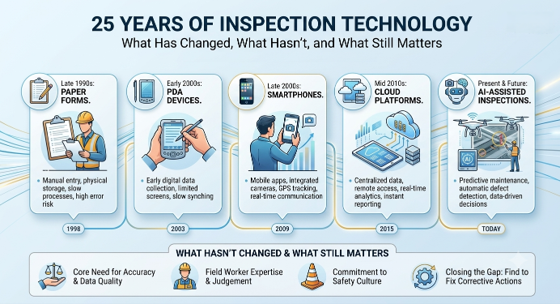
The most visible shift has been the move from paper to digital. Over the past 25 years, clipboards gave way to PDAs, PDAs gave way to tablets and smartphones, and smartphones gave way to purpose-built mobile applications designed specifically for field data collection. Today, an inspector on a mine site, a construction scaffold, or a warehouse floor can complete a structured inspection, photograph a deficiency, assign a corrective action, and submit a report before they have walked back to the site office. That workflow used to take days.
This shift has been especially significant in industries where connectivity cannot be assumed. A true offline-capable inspection app lets an inspector on a remote pipeline, an underground mine level, or a rural property complete a full inspection with zero signal, then sync automatically the moment a connection is available. Early digital tools that depended on a live connection failed field teams in exactly the environments where inspections mattered most.
The data
Paper inspections produced records. Digital inspections produce data. That distinction matters more than it might first appear. A paper record tells you what happened at a point in time. Digital data, accumulated across hundreds or thousands of inspections, tells you what is happening across your entire operation. Trends become visible. Patterns emerge. You can see that the same piece of equipment fails its pre-start check every third Monday, or that one particular site consistently generates corrective actions that are never closed. That kind of insight was impossible to extract from a filing cabinet.
This is also where asset management and inspection data started to merge. Instead of a checklist existing as an isolated event, it now sits inside the full history of the asset it relates to, alongside every prior inspection, work order, and repair. That combined history is what allows organisations to move from reactive maintenance to genuinely predictive maintenance.
Speed and accountability
The time between a deficiency being identified and someone being responsible for fixing it has compressed dramatically. Automated alerts, email triggers, and escalation workflows mean that a finding does not sit in a queue waiting for a supervisor to read their paperwork. The right person is notified immediately, with the right information. This has genuinely changed accountability structures in many organisations, because the system creates a record of who knew what and when.
Modern CMMS and work order platforms take this further by turning a failed inspection item directly into an assigned, trackable task, complete with the photographic evidence, the asset context, and a due date. That closed loop between finding and fixing is one of the genuine structural improvements this industry has made over the past 25 years, even if, as covered below, closing the loop in practice is still harder than the technology makes it look.
The technology layers
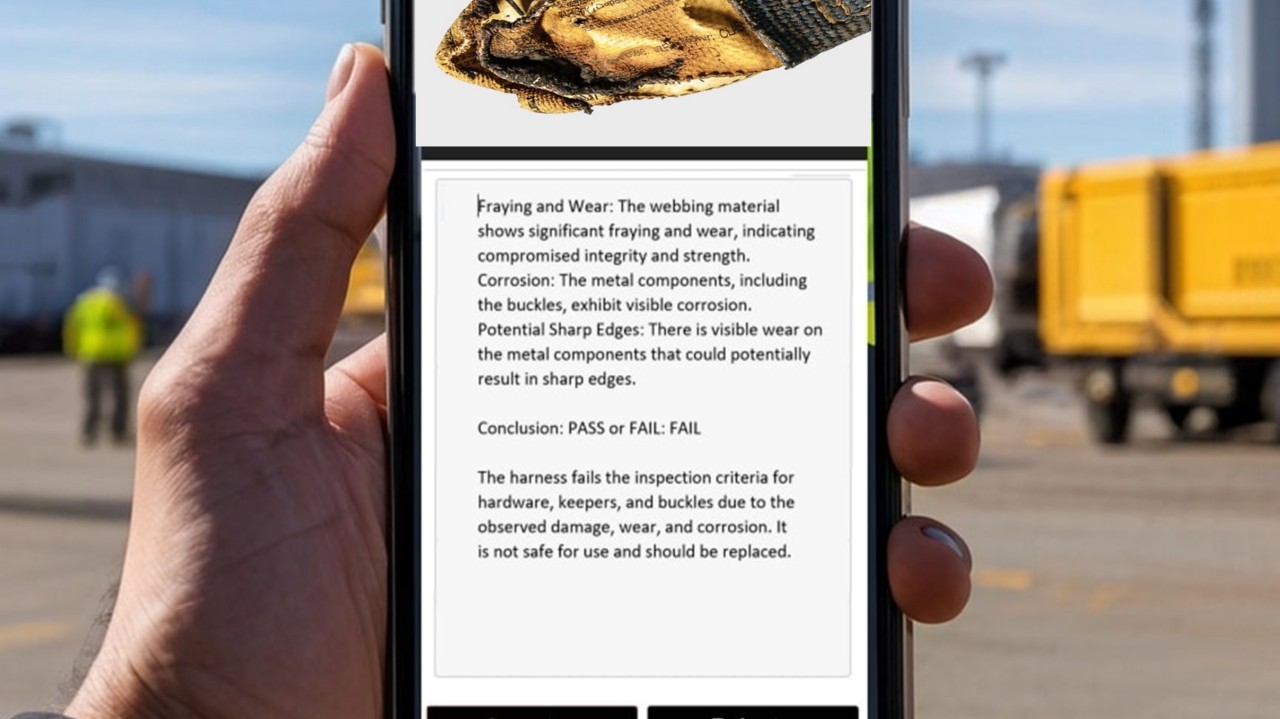
Mobile and cloud were the first wave. Barcode and QR code scanning, Bluetooth beacons, and RFID tagging added asset tracking to inspection workflows. Voice recognition arrived as a way to capture data hands-free in environments where an inspector's hands were occupied, or gloves made touchscreen use impractical. Most recently, AI-powered image recognition has introduced the ability to detect defects and anomalies from photos captured during an inspection, effectively giving the software the ability to flag issues the inspector may have missed.
Each layer has added genuine capability, and the pace of change has accelerated rather than slowed. AI-powered inspection tools now compare photos across multiple inspection runs to flag gradual deterioration a human eye might miss between visits, and can recommend which photos an inspector should capture based on the asset type and known failure patterns. Real-time hazard detection has also extended into physical safety systems, with proximity alert systems now able to warn workers and plant operators of collision risk before an incident occurs, rather than relying purely on after-the-fact incident review.
The technology layers added over 25 years
- Mobile devices and cloud sync, replacing paper and manual data entry
- Barcode, QR code, and RFID scanning for instant asset identification
- Bluetooth beacons for automated location and proximity tracking
- Voice recognition for hands-free data capture in gloved or hazardous environments
- AI-powered image recognition to detect defects and anomalies automatically
- Automated corrective action routing and escalation workflows
Regulatory alignment
Standards like ISO 45001 (occupational health and safety management), ISO 31000 (risk management), and various industry-specific frameworks have become easier to implement and demonstrate compliance against when the underlying data is digital, structured, and searchable. Audit preparation, which once meant days of manually collating paper records, can now be largely automated through compliance and quality assurance tooling that keeps every inspection, certification, and corrective action in one searchable, exportable system.
This has been particularly valuable in heavily regulated sectors. Mining operators and oil and gas operators now routinely produce audit-ready compliance documentation in minutes rather than days, while construction and manufacturing businesses use the same structured data to satisfy client, insurer, and regulator requirements without duplicating effort across multiple systems.
What Hasn't Changed
The underlying human behaviour problem
Technology has made it easier to conduct an inspection correctly. It has not made people more inclined to conduct one correctly when they are under time pressure, fatigued, or operating in a culture where cutting corners is quietly accepted. Checkbox fatigue is real. An inspector who was inclined to tick everything as compliant on a paper form is equally capable of ticking everything as compliant on a tablet. The medium changed. The incentive structure often didn't.
The research on this is fairly consistent. Digital tools improve safety outcomes most significantly in organisations that already have strong safety cultures. In organisations where safety is treated as a compliance exercise rather than a genuine priority, digitising the process tends to produce faster compliance exercises, not better safety outcomes.
The gap between finding and fixing
This is perhaps the most persistent failure point in inspection practice, across every era of technology. Deficiencies get recorded. They do not always get resolved. In the paper era, findings disappeared into filing systems. In the early digital era, they disappeared into spreadsheets or email threads. Even with sophisticated corrective action workflows, organisations still struggle with overdue actions, disputed ownership, and the gradual accumulation of open findings that nobody is actively managing.
The technology has improved the visibility of this problem considerably. It has not solved it. Solving it requires management commitment, clear accountability, and a willingness to treat an unresolved finding as a genuine organisational failure rather than an administrative backlog. This is exactly the gap that structured incident and accident management processes are designed to close, by ensuring every finding has a named owner, a due date, and visible escalation if it slips.
The quality of the inspection itself
A well-designed digital form can prompt an inspector to check specific items, photograph specific components, and record specific measurements. What it cannot do is replace the knowledge, experience, and judgement of a competent inspector who knows what a failing weld looks like, understands the operational context of the equipment they are assessing, and can identify a risk that is not on the checklist. AI image recognition is beginning to address part of this gap, particularly for repetitive, visually consistent defect types.
But for complex assessments in dynamic environments, the inspector's expertise remains the irreplaceable input. Technology is a tool to support that expertise, not a substitute for developing it in the first place. This is a theme worth exploring further; it is covered in more depth in our related article on why AI doesn't replace inspectors.
Resistance to adoption
Every generation of inspection technology has faced the same adoption challenge. PDAs were too complicated. Smartphones were too fragile for site environments. Mobile apps require too much training. AI felt threatening. The specific objections change with each technology cycle; the pattern of resistance does not. Organisations that invest in change management alongside technology deployment consistently achieve better outcomes than those that deploy software and assume people will adapt.
Teams that plan the transition properly, rather than simply switching systems overnight, tend to fare much better. Our 6-step paper to digital playbook was built specifically around this pattern: the organisations that succeed treat the technology rollout as a change management project first and a software implementation second.
The fundamentals of what a good inspection is
Strip away every layer of technology, and an inspection is still, at its core, a structured observation made by a competent person against defined criteria, with a mechanism for acting on what is found. That was true in 1999 and it is true now. The best inspection programs today are the ones that have kept that principle clear while using technology to make every part of the process faster, more consistent, and more accountable.
What This Means Practically
If you are evaluating inspection technology, or trying to improve an existing program, the 25-year arc of this industry suggests a few things worth keeping in mind.
The technology is genuinely better than it has ever been. The gap between what is technically possible and what most organisations are actually doing is significant, and closing that gap is worth the investment. But technology selection is not the most important decision you will make. The most important decisions are about the quality of your inspection criteria, the competence of your inspectors, the clarity of your corrective action ownership, and the degree to which your leadership actually treats inspection findings as information worth acting on.
Organisations that get those things right tend to get value from every technology generation. Organisations that don't tend to find that each new platform produces the same results as the last one, just faster. Twenty-five years of technological development have undoubtedly improved the speed, visibility, and traceability of inspection programs. Information that once sat in filing cabinets is now available in real time, and organisations have access to levels of operational insight that were previously impossible to achieve. Yet the core challenges remain remarkably familiar. Effective inspections still depend on competent people, clear processes, timely corrective actions, and leadership commitment. Technology can support each of these elements, but it cannot replace them.
What to prioritise when evaluating inspection technology
- Inspection criteria that reflect real operational risk, not a generic template
- A true offline-capable platform for sites with unreliable connectivity
- Corrective action workflows with clear ownership and visible escalation
- Change management alongside the software rollout, not instead of it
- Leadership that treats an open finding as unfinished business, not paperwork
- A partner with the industry experience to configure the system around your risks
Perhaps the most enduring lesson from the past quarter century is that successful inspection programs are built on discipline rather than software alone. The tools continue to evolve, but the fundamentals of identifying hazards, assessing risk, and acting on findings remain as important today as they were a generation ago. Pervidi has spent that same 25 years building the tools to support that discipline, from the earliest mobile inspection apps through to today's AI-powered platform, and the lesson has held throughout: the software should serve the discipline, not replace it. You can read more about that history on our about page.
See what 25 years of inspection technology looks like today
Book a demo to see how Pervidi combines offline-capable mobile inspections, AI-powered defect detection, and closed-loop corrective actions in one platform built on 25 years of field experience.
Book a demoNaaman Shibi is a VP at Pervidi Software, leading the adoption of AI-powered inspection and compliance solutions across industries including mining and construction. With more than 25 years of experience in digital transformation, Naaman has helped organisations replace paper processes with efficient mobile technology. His focus is on delivering practical innovations, from AI image integration to predictive maintenance, that empower frontline teams and improve operational outcomes.